Search This Blog

Welcome to my blog
Showing posts with label Tate Modern. Show all posts

Monday, 18 June 2012

Spin Painting With Damien Hirst


Last Thursday I had the opportunity to take a colleague and a group of 8 children to Covent Garden to see artist Damien Hirst create his famous Spin Painting art. At the event organised by Tate Modern my talented group of eight met, spoke and worked alongside Hirst and his team from Science LTD. 
Damien Hirst and Camila Batmanghelidjh creating a spin painting

The scene before the painting commenced


After placing on their wristbands and “I o DH” badge, the children chose a template from a selection of six images that related to Hirst’s catalogue of work. These included a sharks head, a rocket, a heart, a spot, a butterfly and a skull. The children then patiently waited their turn to create their own unique piece of spin art with the assistance of Hirst, Kids Company founder Camila Batmanghelidjh, Michelle Ackerley from Blue Peter and of course Hirst’s expert team Science LTD. The paintings are made by first pinning the template to the turntable, applying a coat of water to the surface of the template before rotating the template on a flat turntable while brightly coloured paints are poured onto it by the children from above.
The children thoroughly enjoyed the atmosphere of the event, exploring art in a public space and discovering the amazing sights and sounds that London offers. It was inspiring to see their eyes light up at seeing tourist attractions they had never seen before, the eagerness to document the day with photographs and sketches –plus watching them create colourful, stunning artwork.
The event was held in aid of children’s Kids Company, which works to support London’s most vulnerable children with practical, emotional and educational support. 
Hirst, an advocate of Kids Company’s use of art therapy, describes the spin paintings as  “a massive explosion of energy - full of life, colour and optimism,” Hirst said. “All children are artists, so it's great to be getting all these kids together in Covent Garden to make them.”
Hirst’s first interest in spin art arose as a child after seeing the paintings made at school fĂȘtes. Since the early 1990s, he has continued to work on the series which he describes as ‘childish in the positive sense of the word’. Hirst first made spin paintings in the early 1990s and several are on show at the major Hirst retrospective currently at Tate Modern. Check out http://www.tate.org.uk/whats-on/tate-modern/exhibition/damien-hirst for more information on this fantastic exhibition.


The card the children were given to select their Damien Hirst themed template from

The selected template is pinned to the turntable by one of the Science LTD team

Once pinned the template receives a layer of water, this will add to the movement of the paint

The children squirt and lay paint over the top of the template

The Science LTD team encourage the children to lay on plenty of colour. It's at this point I smile with pride at the use of complementary colours - now I know they listen to me when I am harping on about colour theory!!!

How beautiful does this butterfly look?

Spin painting in progress

Damien Hirst displaying his painting which will be auctioned off in October to raise funds for the Kids Company


A selection of the 40 plus paintings produced by the children will go on temporary exhibition at Covent Garden as of tomorrow (June 19th), before they are returned to the children.
A spin painting Hirst created this morning with Kids Company founder Camila Batmanghelidjh will be auctioned at the charity’s Gala Dinner in October of this year.


Damien Hirst and Camila Batmanghelidjh

Damien Hirst being interviewed by Michelle Ackerley from Blue Peter

Friday, 9 December 2011

Teacher Training @ The Tate Modern

This week I was lucky enough to have the opportunity to take a group of teachers from local schools to the Tate Modern, at Southbank as a Professional Development day. The objective of the day was to provide staff with new and interesting ideas of activities that they can do with their pupils when visiting an art gallery and to provide ideas for projects that can be continued at school across the curriculum. Here is what we got up to....
Tate Modern, Southbank, London
As soon as we arrived I put the teachers straight to work. They were all tasked with drawing an outline of the building. This was used to document the day. Teachers were instructed to fill in their outline drawing with rubbings, drawings, words, artists names, quotes, collage receipts/pictures etc collected throughout the day, creating a visual documents of their day at Tate. These look great as an exciting and informative wall display back at school.
Our first activity actually inside the Tate was to select our favourite piece of work from the work in room 3, level 5 Energy and process. Participants were instructed to walk around the room, NOT to read the curators comments and respond to the piece. After each person had selected their piece, the curators comments were read to see if this changed our opinion or thoughts on a piece of work. Quite often we are daunted by "getting it wrong", when looking at art, but essentially art is about observing and responding. Some pieces will move you more than others and create a deeper connection for a whole range of reasons , you social upbringing, colour association, mood, what is going on in your life etc etc. This led onto the timeless discussion - What makes good art? This is a great discussion to have with children in a gallery space. You can observe how people look at art, do they stop, stare, walk by, stand at chat? Does everyone stop at the same pieces? How many people have the guide glued to their ear? Observing others observing art can be just as interesting and intriguing as the piece of art work itself.
A good discussion on this can be found at http://painting.about.com/cs/inspiration/a/goodart.htm
After our discussion, I asked each participant to draw their favourite piece from this room. We had now spent quite a bit of time in this room, looking at the works, discussing what we liked, what we didn't like and sharing viewpoints. We had spent time getting to know the works and taking time to look at them. I often see crowds of children dashing around the gallery trying to find a piece to draw and not actually spending any real time with the piece. This activity allows the group to focus on a specific room with limited pieces of work. It stops that overwhelming feeling that you can get when visiting a gallery such as the Tate with it's numerous floor, rooms and works. We seem to go into a state of panic, trying to view everything in one day - sometimes we should remember less is more. The objective of this activity was also to inform techers of how it feels to be that child tasked with drawing a piece of work in a public space. It can be unnerving and daunting as well as enjoyable and relaxing. Here the teachers are put in the position of the child.
Robert Morris born 1931Untitled

Susumu Koshimizu born 1944 From Surface to Surface


Giovanni Anselmo born 1934 Direction

Richard Tuttle born 19418th Paper Octagonal

Keith Sonnier born 1941 Red Flocked Wall

Gilberto Zorio born 1944 Terracotta Circle

Giuseppe Penone born 1947 Tree of 12 Metres

Mario Merz 1925-2003Lingotto

So what one was your Favourite? Why?
The next task was to incorporate the use of the senses when looking at art. This activity is a great way of engaging children in observing and discussing art within a gallery environment. It is also great fun for adults. Participants were instructed to work within groups, stand in front of a painting/sculpture and discuss what it tastes like or what it smells like. Not as bonkers as it sounds. Many a great artist has created work by what they hear, see, smell and taste when thinking about a subject. This is called Synesthesia - Which is a neurological based condition in which stimulation of one sensory or cognitive pathway leads to automatic, involuntary experiences in a second sensory or cognitive pathway e.g. seeing a letter or a number as a specific colour.
Have a go next time you visit a gallery, let your senses take over and see if you have a reaction. You could be stimulated by colours, images, a shape or a texture. It is a great way of spending time with a piece of art work and observing and discussing the piece with peers/friends.
Once we had smelt and tasted out pictures is was time to incorporate a bit of visual literacy. In groups, participants chose a picture and were tasked with creating a story using a simple storyboard format. Each group had to take into account what they could hear, smell, see, taste and touch within the piece as their starting point. Participants sketched their story working on the acronym S.P.I.C.E S=Setting, P=Plot, I=Ideas, C= Characters and E=Ending.
Only action words were allowed - no text just images. Once the groups completed their drawings I collected them in and swapped them around (I know how mean). Each group then had to interpret the drawings and write the story based on their interpretation of the pictures - Plus as a group they had to workout what picture they thought the story had been inspired by. This activity not only encourages creative writing, interpretation skills and active listening but creates a new dialogue around a piece of art work and once again presents an opportunity for participants to spend time with a piece of work, react, respond and record their viewpoints.


Drawing the story
"The Publisher" was a favourite amongst the group, with some of the ladies seeing him as a George Cloney-secret agent/assassin type of character. They smelt his aftershave, office aroma and even worked out he was wearing Calvin Klein's!
When visiting a gallery it is always worth doing a bit of research beforehand and to look at what activities and facilities the gallery has that you can utilise. A new activity that has recently be launched by Tate is Tate Trumps. Many of you will remember back to your childhood of spending many a fun afternoon playing top trumps, where the objective is to win all of your opponents cards by selecting a category and hoping your card has the best rating. Tate has launched an interactive version of this game that has three modes: Mood, Collection and Battle.
You can download it to your iPhone or iPod Touch for free, and then you're ready you roam the gallery looking for artworks you think will score highly in one of the three modes.
In Battle mode, you need to ask yourself the question, "If this artwork came to life, how good would it be in a fight?". In Mood mode, you're looking for artworks you think are menacing, exhilarating or absurd. Or, if you wish you had a gallery of your own, try Collector mode, and find pictures which are famous, recently produced or practical to house.
Once you've formed your collection, meet up with your friends, and play a fun game of trumps to see who did the best.
We played an adapted version of this game. Participants were given 30  minutes in room 2 level 3 Poetry and Dreams and asked to select 10 pieces of work that they think would win in their given mode. One group had battle and one group had collector. Children love this activity and it really works to spark their imagination. They have to consider all elements of the picture, the size and scale of the works, what materials they are made out of and in some cases the practicality of the piece. These may not be observations they would normally make when looking at a piece of work, but add in a bit of friendly competition and it is game on.
Why not have a go yourself - look at these two images - in a battle which one would win? Think about the paintings strength, size and agility of the image.

I hope that you have found this interesting and if you would like any more information of the activities discussed above and lesson plans please contact me on lisamart@hotmail.co.uk . I hope that this has inspired you whether you are a teacher, student, art fan or blog reader to be a bit more inventive and interactive with art work the next tie you visit a gallery - have fun

Monday, 5 September 2011

From Morning Till Night

 This is an image of the photo that I was sent - Position 50. I found out in a conversation with some of the Czech Villagers, that this is a factory that makes alcohol. One of the villagers husband used to work at the building and explained to me that the picture was taken from the forest.
This Saturday I had the pleasure of spending 12 hours drawing as part of the From Morning Till Night commission by Tate Modern of the Artist Katerina Seda. This was an amazing event and a great opportunity for those involved to meet some very talented artists and interesting people. I arrived at the Tate Modern at 6am and was greeted with a smile by some tired looking staff. All artists were given their position number, badge, translation book, map and any materials they had requested. At 6:30 I placed myself on the far corner of the Tate by the millennium bridge and got to work on my image. I really enjoy drawing outside and the early start (although a bit of a shock to my system) presented me with a beautiful and peaceful environment to work in. As the morning progressed Czech Republic Villagers started to walk past, offering a smile and comments on the site I was drawing whilst carrying out the action or activity Seda had provided for them.
So what was the project about - Katerina Seda invited 80 residents of all ages from Bedrichovice, a small village in The Czech Republic, to perform a one-day action in London. In the village the inhabitants would normally leave the village at sunrise to go work, carry out chores and go to school - only returning home at sunset. This limits social interaction with their neighbours, with many villagers only meeting when they bump into each other accidently. Seda wanted to bring the villagers to London and recreate the village in an unfamiliar context. The villagers were given tasks to perform such as building a den out of cardboard boxes, do washing, playing badminton, riding a London Barclay cycle, taking photos, celebrating a birthday and so forth. These actions and activities provided the opportunity for the villagers to integrate in a new way, within the imaginary border around Tate Modern to St Paul Cathedral.
In addition to the villagers 80 UK based artists were invited to assist Seda in representing these imaginary borders. Each artist was sent a picture from the village and provided with a spot positioned at the outskirts of the imaginary village to draw or paint the picture. The general idea, was that the artists would slowly create pictorial images of the village to the passing London visitors whilst the Czech Villagers engaged in social activities within the imaginary village borders.
These are some of my pictures of events of the day and the extensive range of art work produced as part of the commission.


 The start of my drawing at 6:30am....
 In Position 51 was Max Dixon, Who created this stunning Chalk Pastel image
 
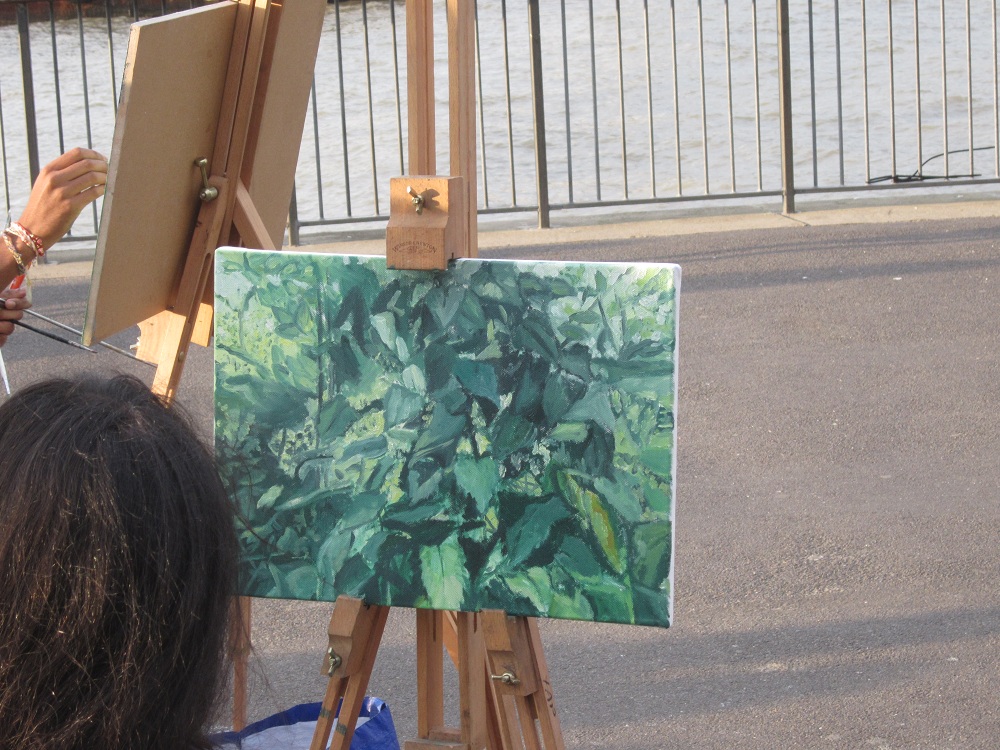
These exquisite acrylic paintings were created by Layla Al-Marzooqi, describing some of the foliage and the side view of the factory.
 More foliage being painted along the Southbank
 These two boys were amazing throughout the day. They constantly had smiles upon thier faces and were checking on the artists to make sure we were all ok. It was great to observe them enjoying building their den and chatting with them about their home.
 Me and my coffee cups at Position 50
 My finished drawing, completed using water soluble crayons.
  
After completing my picture I tried to draw it from memory. I did cheat a little referring to the  photo for the initial outline, but I promise I did not look at it once when adding detail and shading. If you look at the foreground you will notice my lack of imagination with the foliage which all seems to be leaning in the same direction. The image above has a bit more movement to it.
The images below show a snapshot of the village and the incredible work created by some very talented artists. I hope I have got all the names correct and apologies if there are any spelling mistakes.
 Ade Awofadeju detailed pen sketch
 Isabell Markus expressive watercolour
 Debbie Atkinson breathtaking pen and ink
 Inez Schrader - if you look closely you will see that Inez got the villagers who passed her by to sign her picture, actually giving them ownership and putting them in the picture.

  I did not get the names of the artists that created the two images above
 Katerina Seda and her Intepreter address the villagers and artists at the evening celebration
If you would like to find out more about this project have a look at the following link http://www.tate.org.uk/modern/eventseducation/musicperform/24135.htm or read about events of the Tate Blog http://blog.tate.org.uk/?s=katerina+seda

Sunday, 14 August 2011

Live, Laugh Love - Working title

This weekend I have spent some time working on sculptures for the A127 art trail in September... yes I know, time is ticking!!! As I have often mentioned I love working with paper and I am especially interested in the quality of newspaper as a sculpture medium. For these pieces I am experimenting with the paper bowl technique used at a recent workshop for Access Art in Cambridge. I want to explore how these units can be manipulated and linked together. The idea that something that is easily discarded, thrown away or used to line a cat tray can be made into a thing of beauty, appeals to me. For the first time in a long while I am not sure where these pieces are taking me. I have ideas of the basic forms and am enjoying watching the pieces manifest themselves, grow and take on their own form. There is a lot of autobiography in my work and sitting writing the initial thought process evokes a personal response to life situations that I face at the moment. I use my art work to explore emotions, relay observations and discuss issues faced in day to day life. I am very lucky to be part of an extremely strong and close family, who unfortunately are facing a brutal battle against Cancer - My intention for this series is to explore family bonds, emotions, fears and hopes. This series is titled "Cell story" , the piece pictured below "Live, Laugh, Love".

 A series of units made ready to be worked on, these units are made
with rolled pieces of newspaper spiralled together
 Black acrylic paints has been used to bond the paper together and help to keep the form of the sculpture. PVA glue can work just as well.
 The three sections of the sculpture start to take form
 This is the general idea for the finished piece in it's raw form. The rolled newspaper produces a stunning finish to the sculptures which I think I will explore in additional sculptures.
The three units with their undercoats of white acrylic paint.
 I am still planning the final design for which I am planning a trip to the Tate Modern to have a look at some of Fiona Rae's, Jasper Johns and Chris Ofili's work for inspiration.